Variational Autoencoders
Variational Auto-Encoders (VAE) [VAEKW13] is one of the most widely used deep generative models. In this tutorial, we show how to implement VAE in ZhuSuan step by step. The full script is at examples/variational_autoencoders/vae.py.
The generative process of a VAE for modeling binarized MNIST data is as follows:
This generative process is a stereotype for deep generative models, which starts with a latent representation (\(z\)) sampled from a simple distribution (such as standard Normal). Then the samples are forwarded through a deep neural network (\(f_{NN}\)) to capture the complex generative process of high dimensional observations such as images. Finally, some noise is added to the output to get a tractable likelihood for the model. For binarized MNIST, the observation noise is chosen to be Bernoulli, with its parameters output by the neural network.
Build the model
In ZhuSuan, a model is constructed using
BayesianNet, which describes a directed
graphical model, i.e., Bayesian networks.
import zhusuan as zs

class Generator(BayesianNet):
    def __init__(self, x_dim, z_dim, batch_size):
        # Initialize...
    def execute(self, observed):
        # Forward propagation...
Following the generative process, first we need a standard Normal
distribution to generate the latent representations (\(z\)).
As presented in our graphical model, the data is generated in batches with
batch size n, and for each data, the latent representation is of
dimension z_dim.
So we add a stochastic node by stochastic_node method to generate samples of shape
[n, z_dim]:
# z ~ N(z|0, I)
mean = jt.zeros([batch_size, z_dim])
std = jt.ones([batch_size, z_dim])

z = self.stochastic_node('Normal',
                         name='z',
                         mean=mean,
                         std=std,
                         reparameterize=False,
                         reduce_mean_dims=[0],
                         reduce_sum_dims=[1])
The method bn.normal is a helper function that creates a
Normal distribution and adds a
stochastic node that follows this distribution to the
BayesianNet instance.
The returned z is a sample of StochasticTensor, which
can be mixed with Vars and fed into any Jittor operations.
Note
To learn more about Distribution and
BayesianNet. Please refer to
Basic Concepts in ZhuSuan.
The shape of z_mean is [n, z_dim], which means that
we have [n, z_dim] independent inputs fed into the univariate
Normal distribution.
The shape of samples and probabilities evaluated at this node should
be of shape [n, z_dim]. However, what we want in modeling MNIST data, is a
batch of [n] independent events, with each one producing samples of z
that is of shape [z_dim], which is the dimension of latent representations.
And the probabilities in every single event in the batch should be evaluated
together, so the shape of local probabilities should be [n] instead of
[n, z_dim]. In ZhuSuan-Jittor, the way to achieve this is by setting reduce_mean_dims and reduce_sum_dims.
Then we build a neural network of two fully-connected layers with \(z\) as the input, which is supposed to learn the complex transformation that generates images from their latent representations:
# x_logits = f_NN(z)
# In __init__
self.fc1 = nn.Linear(z_dim, 500)
self.act1 = nn.Relu()
self.fc2 = nn.Linear(500, 500)
self.act2 = nn.Relu()
self.fc2_ = nn.Linear(500, x_dim)

# In execute
x_logits = self.fc2_(self.act2(self.fc2(self.act1(self.fc1(z)))))
Next, we add an observation distribution (noise) that follows the Bernoulli distribution to get a tractable likelihood when evaluating the probability of an image:
# x ~ Bernoulli(x|sigmoid(x_logits))
x_probs = nn.Sigmoid()(x_logits)
self.sn('Bernoulli',
        name='x',
        probs=x_probs,
        reduce_mean_dims=[0],
        reduce_sum_dims=[1])
Note
The Bernoulli distribution
accepts log-odds of probabilities instead of probabilities.
This is designed for numeric stability reasons.
Putting together, the code for constructing a VAE is:
class Generator(BayesianNet):
    def __init__(self, x_dim, z_dim, batch_size):
        super().__init__()
        self.x_dim = x_dim
        self.z_dim = z_dim
        self.batch_size = batch_size

        self.fc1 = nn.Linear(z_dim, 500)
        self.act1 = nn.Relu()
        self.fc2 = nn.Linear(500, 500)
        self.act2 = nn.Relu()

        self.fc2_ = nn.Linear(500, x_dim)
        self.act2_ = nn.Sigmoid()

    def execute(self, observed):
        self.observe(observed)
        mean = jt.zeros([self.batch_size, self.z_dim])
        std = jt.ones([self.batch_size, self.z_dim])

        z = self.sn('Normal',
                    name='z',
                    mean=mean,
                    std=std,
                    reparameterize=False,
                    reduce_mean_dims=[0],
                    reduce_sum_dims=[1])
        x_mean = self.act2_(self.fc2_(self.act2(self.fc2(self.act1(self.fc1(z))))))
        sample_x = self.sn('Bernoulli',
                        name='x',
                        probs=x_mean,
                        reduce_mean_dims=[0],
                        reduce_sum_dims=[1])
        return self

generator = Generator(x_dim, z_dim, batch_size)
Inference and learning
Having built the model, the next step is to learn it from binarized MNIST images. We conduct Maximum Likelihood learning, that is, we are going to maximize the log likelihood of data in our model:
where \(\theta\) is the model parameter.
Note
In this variational autoencoder, the model parameter is the network
weights, in other words, it’s the Jittor Vars created in the
fully_connected layers.
However, the model we defined has not only the observation (\(x\)) but also latent representation (\(z\)). This makes it hard for us to compute \(p_{\theta}(x)\), which we call the marginal likelihood of \(x\), because we only know the joint likelihood of the model:
while computing the marginal likelihood requires an integral over latent representation, which is generally intractable:
The intractable integral problem is a fundamental challenge in learning latent variable models like VAEs. Fortunately, the machine learning society has developed many approximate methods to address it. One of them is Variational Inference. As the intuition is very simple, we briefly introduce it below.
Because directly optimizing \(\log p_{\theta}(x)\) is infeasible, we choose to optimize a lower bound of it. The lower bound is constructed as
where \(q_{\phi}(z|x)\) is a user-specified distribution of \(z\) (called variational posterior) that is chosen to match the true posterior \(p_{\theta}(z|x)\). The lower bound is equal to the marginal log likelihood if and only if \(q_{\phi}(z|x) = p_{\theta}(z|x)\), when the Kullback–Leibler divergence between them (\(\mathrm{KL}(q_{\phi}(z|x)\|p_{\theta}(z|x))\)) is zero.
Note
In Bayesian Statistics, the process represented by the Bayes’ rule
is called Bayesian Inference, where \(p(z)\) is called the prior, \(p(x|z)\) is the conditional likelihood, \(p(x)\) is the marginal likelihood or evidence, and \(p(z|x)\) is known as the posterior.
This lower bound is usually called Evidence Lower Bound (ELBO). Note that the only probabilities we need to evaluate in it is the joint likelihood and the probability of the variational posterior.
In variational autoencoder, the variational posterior (\(q_{\phi}(z|x)\)) is also parameterized by a neural network (\(g\)), which accepts input \(x\), and outputs the mean and variance of a Normal distribution:
In ZhuSuan, the variational posterior can also be defined as a
BayesianNet . The code for above definition is:
class Variational(BayesianNet):
    def __init__(self, x_dim, z_dim, batch_size):
        super().__init__()
        self.x_dim = x_dim
        self.z_dim = z_dim
        self.batch_size = batch_size

        self.fc1 = nn.Linear(x_dim, 500)
        self.act1 = nn.Relu()
        self.fc2 = nn.Linear(500, 500)
        self.act2 = nn.Relu()

        self.fc3 = nn.Linear(500, z_dim)
        self.fc4 = nn.Linear(500, z_dim)

        self.dist = None

    def execute(self, observed):
        self.observe(observed)
        x = self.observed['x']
        z_logits = self.act2(self.fc2(self.act1(self.fc1(x))))

        z_mean = self.fc3(z_logits)
        z_std = jt.exp(self.fc4(z_logits))

        z = self.sn('Normal',
                    name='z',
                    mean=z_mean,
                    std=z_std,
                    reparameterize=True,
                    reduce_mean_dims=[0],
                    reduce_sum_dims=[1])
        return self

variational = Variational(x_dim, z_dim, batch_size)
Having both model and variational, we can build a model which calculate the lower bound as:
model = zs.variational.ELBO(generator, variational)
The returned lower_bound is an
EvidenceLowerBoundObjective
instance, which is a derivativation of Jittor’s Module. However,
optimizing the lower bound objective needs special care.
The easiest way is to do
stochastic gradient descent
(SGD), which is very common in deep learning literature.
However, the gradient computation here involves taking derivatives of an
expectation, which needs Monte Carlo estimation.
This often induces large variance if not properly handled.
Note
Directly using auto-differentiation to compute the gradients of
EvidenceLowerBoundObjective
often gives you the wrong results.
This is because auto-differentiation is not designed to handle
expectations.
Many solutions have been proposed to estimate the gradient of some
type of variational lower bound (ELBO or others) with relatively low variance.
To make this more automatic and easier to handle, ZhuSuan has wrapped these
gradient estimators all into methods of the corresponding
variational objective (e.g., the
EvidenceLowerBoundObjective).
These functions don’t return gradient estimates but a more convenient
surrogate cost.
Applying SGD on this surrogate cost with
respect to parameters is equivalent to optimizing the
corresponding variational lower bounds using the well-developed low-variance
estimator.
Here we are using the Stochastic Gradient Variational Bayes (SGVB)
estimator from the original paper of variational autoencoders
[VAEKW13].
This estimator takes benefits of a clever reparameterization trick to
greatly reduce the variance when estimating the gradients of ELBO.
In ZhuSuan, one can use this estimator by calling the method
sgvb()
of the class:~zhusuan.variational.exclusive_kl.EvidenceLowerBoundObjective
instance.
The code for this part is:
# the surrogate cost for optimization
lower_bound = model({'x': batch_x})
Note
For readers who are interested, we provide a detailed explanation of the
sgvb()
estimator used here, though this is not required for you to use
ZhuSuan’s variational functionality.
The key of SGVB estimator is a reparameterization trick, i.e., they reparameterize the random variable \(z\sim q_{\phi}(z|x) = \mathrm{N}(z|\mu_z(x;\phi), \sigma^2_z(x;\phi))\), as
In this way, the expectation can be rewritten with respect to \(\epsilon\):
Thus the gradients with variational parameters \(\phi\) can be directly moved into the expectation, enabling an unbiased low-variance Monte Carlo estimator:
where \(\epsilon_i \sim \mathrm{N}(0, I)\)
Now that we have had the cost, the next step is to do the stochastic gradient descent. Jittor provides many advanced optimizers that improves the plain SGD, among which Adam [VAEKB14] is probably the most popular one in deep learning society. Here we are going to use Jittor’s Adam optimizer to do the learning:
optimizer = jt.optim.Adam(model.parameters(), 1e-3)

# During each iter
optimizer.step(lower_bound)
Generate images
What we’ve done above is to define and learn the model. To see how it
performs, we would like to let it generate some images in the learning process.
We put the Var x_mean in the cache of Generator to keep track of it.
class Generator(BayesianNet):
def __init__(self, x_dim, z_dim, batch_size):
    ...

def execute(self, observed):
    ...
    x_probs = self.act2_(self.fc2_(self.act2(self.fc2(self.act1(self.fc1(z))))))
    self.cache['x_mean'] = x_probs
    self.sn('Bernoulli',
            name='x',
            probs=x_probs,
            reduce_mean_dims=[0],
            reduce_sum_dims=[1])
    ...
so that we can easily access it from a
BayesianNet instance.
For random generations, no observation about the model is made, so we
pass an empty observation to the model and get the generated sample by the cache['x_mean'] of
Generator:
cache = generator({}).cache
sample_gen = cache['x_mean']
Run gradient descent
Now, everything is good before a run. So we could just run the training loop, print statistics, and write generated images to disk using Jittor:
for epoch in range(epoch_size):
    for step in range(num_batches):
        x = jt.array(x_train[step * batch_size:min((step + 1) * batch_size, len_)])
        x = jt.reshape(x, [-1, x_dim])
        if x.shape[0] != batch_size:
            break
        loss = model({'x': x})
        optimizer.step(loss)
        if (step + 1) % 100 == 0:
            print("Epoch[{}/{}], Step [{}/{}], Loss: {:.4f}".format(epoch + 1, epoch_size, step + 1, num_batches,
                                                                    float(loss.numpy())))

batch_x = x_test[0:64]
batch_x = jt.array(batch_x)

cache = generator({}).cache
sample_gen = cache['x_mean'].numpy()
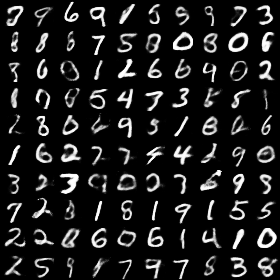
Below is a sample image of random generations from the model. Keep watching them and have fun :)
References